
Contrapposto
We are losing the war for Access to Justice. And we keep aiming our attacks on our own side.

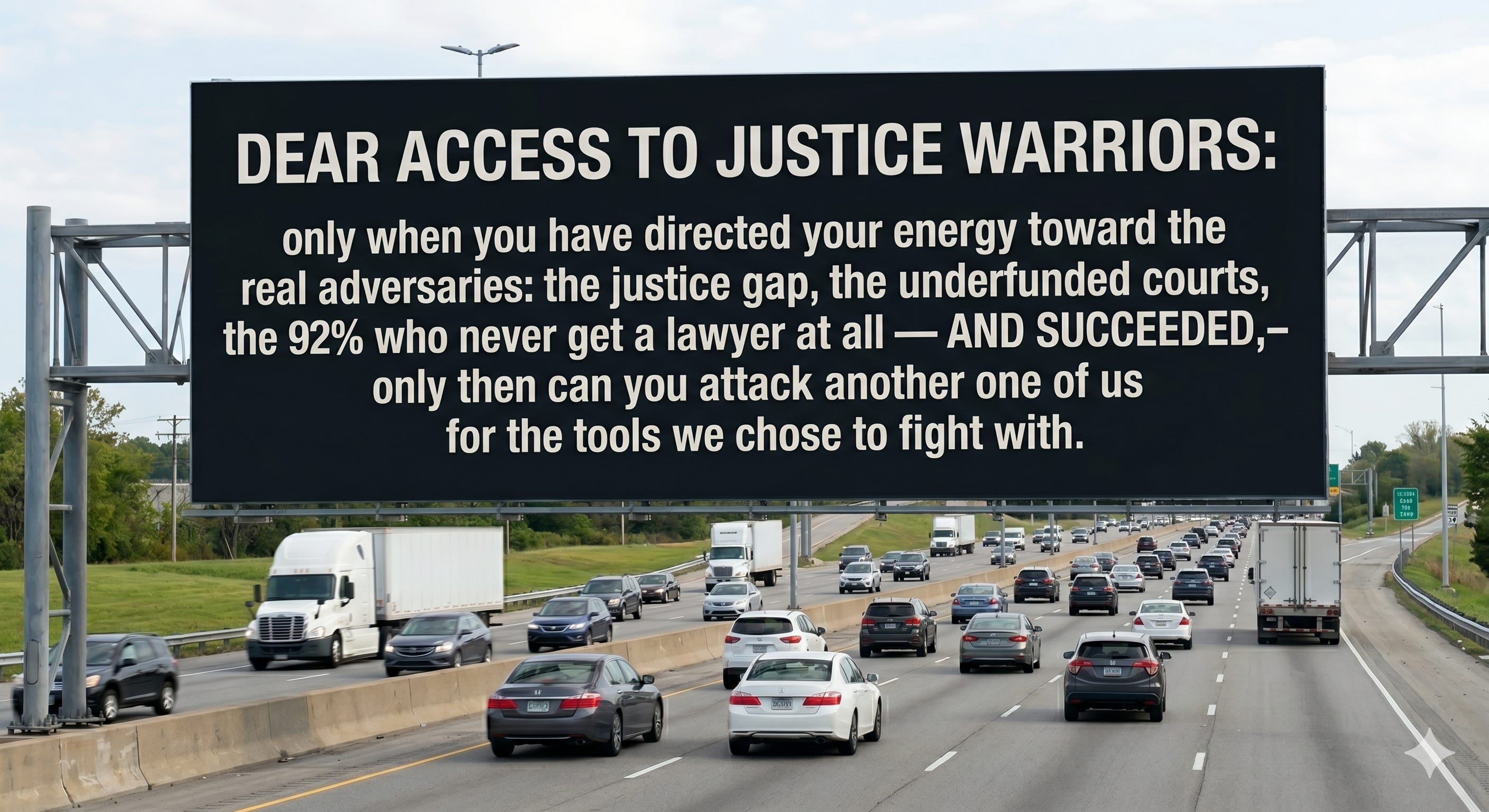
As you know, I’m on a trip to India and I’m struggling with jet-lag- waking up at 4AM every morning and struggling to adjust to the time difference. I brought a new book on this trip, written by a favorite writer, Dave Eggers, called “Contrapposto,” which means “counterpose” in Italian. The term refers to the off-balance position expressed by models who pose for artists. Early this morning, reading from the book to pass the still, dark, morning, I was moved by the following passage:
To Artists of Any Kind; Only when you have vanquished all fascists... Only when you have defeated all tyrants... Only when you have lifted the burden from all the world’s oppressed and freed all the innocents imprisoned... Only when every woman can do as she wishes with her body and her life... Only when every family has shelter and every child is fed...Only when every laborer is paid fairly and treated humanely... Only when every human is free to move as they wish, love as they wish, live as they wish... Only then—only when you have directed your anger toward the real demons of the world, its despots and tyrants, and have vanquished them all— only then can you attack another artist?”
In this passage, a retired art teacher laments the art-world culture of art-criticism in which true effort, imagination, and skill are discredited in favor of theory, dogma, and trend. I thought: is there a parallel from this to what is happening in the access to justice community? So I rewrote the passage to apply to us:
“To Public Interest Lawyers of Any Kind:
Only when you have vanquished every eviction notice that shouldn’t have been filed... Only when you have defeated every predatory landlord, every wage thief, every debt collector armed with a default judgment... Only when you have lifted the burden from every tenant who faced Housing Court alone... Only when every family has shelter and every worker has been paid what they’re owed... Only when every immigrant has had someone in their corner and every person in crisis has had a lawyer who showed up... Only when every child aging out of foster care has had counsel, and every survivor of domestic violence has had an advocate who knew the system cold...
Only then — only when you have directed your energy toward the real adversaries: the justice gap, the underfunded courts, the 92% who never get a lawyer at all — only then can you attack another public interest lawyer for the tools they chose to fight with.”
Roughly 92% of the substantial civil legal needs of low-income Americans receive no legal help at all. Not inadequate help. Not imperfect help. Nothing. The landlord has a lawyer. The tenant does not. The debt collector has a lawyer. The debtor does not. The employer has a lawyer. The worker does not.
This is not a staffing problem. It is not a training problem. It is not a problem that can be solved by hiring more lawyers, by running more clinics, by publishing more know-your-rights pamphlets. The math does not work. It has never worked. There are not enough public interest lawyers, and there will never be enough, to close the gap through human labor alone.
So when a colleague deploys a tool — AI-powered, tech-assisted, creatively designed, however you want to describe it — that reaches people who would otherwise get nothing, the correct response is not to interrogate its pedigree. The correct response is to ask: how do we scale this?
When I say tools, I mean all of it.
I mean AI. Large language models that can answer a tenant’s question about their lease at 11pm when no lawyer is available. Chatbots like Roxanne, which has served over 5,000 users with housing legal information — not instead of lawyers, but instead of nothing. Tools like Depositron, which helps NYC tenants recover security deposits they’re legally owed, generating demand letters in minutes from a phone, targeting a problem that costs tenants roughly $500 million a year in unrecovered deposits.
I mean document assembly. HotDocs, Gavel, A2J Author, Docassemble — tools that have existed for decades and still face institutional resistance from organizations that prefer manual intake because it feels more human.
I mean data. Using case management systems to identify patterns in the courts, to predict which clients are most at risk of default judgment, to allocate scarce attorney time to the cases where a lawyer makes the most difference.
I mean plain language. Translating legal concepts into words people actually understand, at a reading level that matches the person receiving the information. This is not dumbing down. This is a form of legal skill that most lawyers have never been trained to perform.
I mean design. Thinking about how a person in crisis actually experiences an intake process, a form, a letter from a government agency — and redesigning it so the person can actually use it.
I mean community. Paralegals, community health workers, social workers, shelter staff, and tenant organizers who can do legal triage and warm handoffs — extending the reach of lawyers into rooms lawyers never enter.
I mean good ideas. Someone at a legal aid clinic figured out that texting appointment reminders reduced no-shows by 40 percent. That is a tool. Someone else figured out that holding intake at a food pantry reached clients who never came to the law office. That is a tool too.
None of these tools are perfect. All of them are imperfect. And all of them are better than nothing — which is what 92% of low-income Americans with civil legal needs currently receive.
What the Cannibals Actually Object To
Let me be honest about what is really happening when a public interest lawyer attacks another public interest lawyer’s tools.
Some of it is legitimate ethics concern. Hallucinations in AI-generated legal advice are a real risk. Unauthorized practice of law is a real doctrine with real consequences. Digital divides are real — not every client has a smartphone, not every neighborhood has reliable internet, not every person in crisis can navigate a chatbot. These concerns deserve serious answers, not dismissal.
But serious answers require engagement. You have to actually look at the tool, understand its safeguards, ask about the review process, identify the gaps, and then — this is the part that usually doesn’t happen — offer to help fix them.
What I see instead is the objection as a veto. A way to feel rigorous without doing the work of rigor. A way to protect institutional turf without admitting that’s what you’re protecting. A way to enforce a standard of perfection that your own work — the manual, under-resourced, overwhelmed, case-by-case approach — has never met and can never meet at scale.
The perfect is not just the enemy of the good here. The perfect is the enemy of all.
Legal aid lawyers can be very resistant to nonlawyer and digital solutions to providing another path to access. Like solos and many small firm practitioners their identity is threatened by digital alternatives, so everyone digs in, in the name of professionalism. But the price is the high percentage of citizens who never get served. At the same time, some of the most positive developments happen in the legal aid community. When major disruptive change is happening there is always tension. I am old enough to remember the upheavals in 1981, when the PC was first introduced.. History repeating, but I believe bright futures ahead.
.